
Re-entry into the list could have far-reaching consequences for Pakistan, including diminished foreign investment, increased borrowing costs, and tighter scrutiny from global financial institutions.

The placement on to grey list could hurt Pakistan's economy as well as its international standing.

India will argue for Pakistan's return to the Financial Action Task Force (FATF) grey list due to its alleged failure to combat money laundering and terror financing. The move comes after recent tensions between the two countries following a terror attack in Pahalgam, India. India believes Pakistan has not adequately addressed the issue of terrorism emanating from its territory and has diverted funds from multilateral agencies towards arms purchases.

Pakistan was put in the inglorious list in 2018 for its failure to check risk of money laundering, leading to corruption and terror financing.

The world should remain clear that Pakistan must continue to take 'credible, verifiable and irreversible' action against terrorism, India said after anti-money laundering watchdog Financial Action Task Force (FATF) removed the neighbouring country from its 'grey list'.

Pakistan is on the verge of strong action by FATF, given its inadequate performance, whereby it managed to pass in only six of 27 items, an official privy to the development said.

The global agency said there are "serious deficiencies" on the part of the country in checking terror-financing and it lacks an effective system to deal with it.

The Paris-based global watchdog for curbing terror financing and money laundering will hold its virtual plenary session from October 21 to 23. It will review Pakistan's progress on the 27-point action plan.

If Pakistan continues with the 'Grey List' or put in 'Dark Grey' list, it would be very difficult for the country to get financial aid from the IMF, the World Bank and the European Union, making its financial condition more precarious.

Pakistan will remain on the 'grey list' of the Financial Action Task Force (FATF) until it further demonstrates that action is being taken against Jamaat-ud-Dawah chief Hafiz Saeed and Jaish-e-Mohammed founder Masood Azhar who are listed as global terrorists by the United Nations, the global anti-money laundering and terror financing watchdog said on Thursday.

The FATF warned Pakistan that if it doesn't complete a full action plan by June, it could lead to consequences on its businesses

Pakistan has been on the grey list of the Paris-based Financial Action Task Force since June 2018 for failing to check money laundering, leading to terror financing, and was given a plan of action to complete it by October 2019.

The anti-terror watchdog has decided to give respite of four months to Pakistan to help her implement remaining recommendations of the task force.

India has been seeking global action against Pakistan for allowing terror safe havens in its territories, and has been pressing for punishing Pakistan-based terrorists involved in a series of attacks in India, including the 2008 Mumbai attack.
Pakistan said no 'new decision' was taken about it at the virtual plenary of the global terror financing watchdog.

The country was, in February, put on the list of jurisdictions that require increased monitoring. These are done to counter money-laundering, terrorist financing, and proliferation financing in a more efficient manner.

Pakistan failed to fulfil six of the 27 mandates so far as a result of which the country continues to be in the grey list of the FATF.

The mandates which Pakistan has failed include action against all United Nations-designated terrorists like Jaish-e-Mohammed chief Azhar, Lashker-e-Tayiba founder Hafiz Saeed and the outfit's operational commander Zakiur Rehman Lakhvi.

India has been maintaining that Pakistan extends regular support to terror groups like Lashkar-e-Taiba, Jaish-e-Mohammad and Hizbul Mujahideen, whose prime target is India, and has urged FATF to take action against Islamabad.
The Financial Action Task Force (FATF) on Friday retained Pakistan on its 'grey list' for failing to check money laundering, leading to terror financing, and asked Islamabad to investigate and prosecute senior leaders and commanders of United Nations-designated terror groups, including Hafiz Saeed and Masood Azhar.

The FATF continuing Pakistan in the 'Grey' list means its downgrading by IMF, World Bank, ADB, EU and also a reduction in risk rating by Moody's, S&P and Fitch.
"The FATF plenary decided continuation of Pakistan in 'Grey List' till its next meeting to be held in October," an official privy to the development told PTI.

Significantly, for the first time, the FATF put Myanmar in the "high risk jurisdictions subject to a call for action", often referred to as the watchdog's black list.
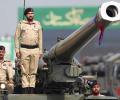
India has decided to submit a dossier at the upcoming Financial Action Task Force (FATF) meeting, calling for Pakistan to be placed back on the grey list of the global money laundering and terrorist financing watchdog.

The FATF statement comes in the backdrop of Indian authorities highlighting Pakistan's persistent support for terrorism and its funnelling of multilateral funds for arms procurement.

In an unexpected move, the government has terminated services of K V Subramanian as the executive director at the International Monetary Fund (IMF) six months ahead of his three-year tenure. The move comes days before the IMF executive board is to consider financial aid for debt-ridden Pakistan.

Pakistan's former foreign minister Bilawal Bhutto-Zardari on Monday said his country will go to war if India denies Islamabad its fair share of water under the Indus Waters Treaty (IWT).

The Dhurandhar movies will undoubtedly shape the minds of the audience much more than news reports, court investigations, books and documentaries. But it is worth remembering that Pakistan's irridentist claims against India's national security have succeeded due to strategic planning, diplomacy, and the unsung heroines and heroes across government agencies, not due to a single maverick leader, points out Shweta Desai.But it is worth to remember that Pakistan's irredentist claims against India's national security have succeeded due to strategic planning, diplomacy, and the unsung heroines and heroes across government agencies -- not a single maverick, points out Shweta Desai.

The government stated that Operation Sindoor was launched in response to a 'barbaric' attack by 'Pakistan-sponsored terrorists,' focusing on dismantling terror infrastructure and neutralizing terrorists likely to be sent across to India.

AIMIM chief Asaduddin Owaisi slammed Pakistani politician Bilawal Bhutto-Zardari for his "blood would flow in rivers" remark and called former cricketer Shahid Afridi a "joker" for his comment on the Pahalgam terror attack. Owaisi also supported India's decision to suspend the Indus Waters Treaty and called for Pakistan to be placed on the FATF grey list. He also advocated for cyber attacks against Pakistan.

'Foreign capital will continue to come directly into India, but companies have realised that GIFT City is a more cost-efficient way of channelling funds.'

Market regulator Sebi on Tuesday said foreign investors from Mauritius will continue to be eligible for FPI registration with increased monitoring as per international norms. The announcement comes after the tax haven was put on the "grey list" of Financial Action Task Force (FATF) -- an inter-governmental policy making body that sets anti-money laundering standards.

Sun Pharma was the top loser in the Sensex pack, shedding 2.37 per cent, followed by HCL Tech, Reliance Industries, IndusInd Bank and L&T.

"Are we not giving a picture that there is no other person and the entire department is full of incompetent people?" a bench headed by Justice B R Gavai told Solicitor General Tushar Mehta.

'Operation Sindoor is still ongoing. The Prime Minister himself said that blood and water cannot flow together, that talks and terrorism cannot go together. So how can we have a cricket match with a country that indulges in terrorism?'

The FATF "strongly" urges Pakistan to swiftly complete its action plan when the last set of action plan items are set to expire.

Former India opener and BJP MP Gautam Gambhir on Friday said that there should not be any relation with Pakistan till cross-border terrorism gets over.

Pakistan is yet to comply with 13 conditions out of the 27-point Action Plan of the FATF including curbing terror financing, enforcement of the laws against the proscribed organisations and improving the legal systems.

Saeed-led JuD is the front organisation for the Lashkar-e-Tayiba which is responsible for carrying out the 2008 Mumbai attack that killed 166 people, including six Americans.

Dawood Ibrahim is wanted in India to face the law of the land for carrying out serial blasts in Mumbai in 1993 in which scores of people were killed and injured.
 © 2026 Rediff.com - Advertise with us - Disclaimer - Privacy Policy - Sitemap - Feedback - About us - Terms of use - Grievances